The Enslavers Around Us
Click a highlighted household on the map to explore where our ancestors were enslaved.
Head's up! Voting for the next Virtual Family Reunion is now open. Cast your vote!
The Enslavers Around Us
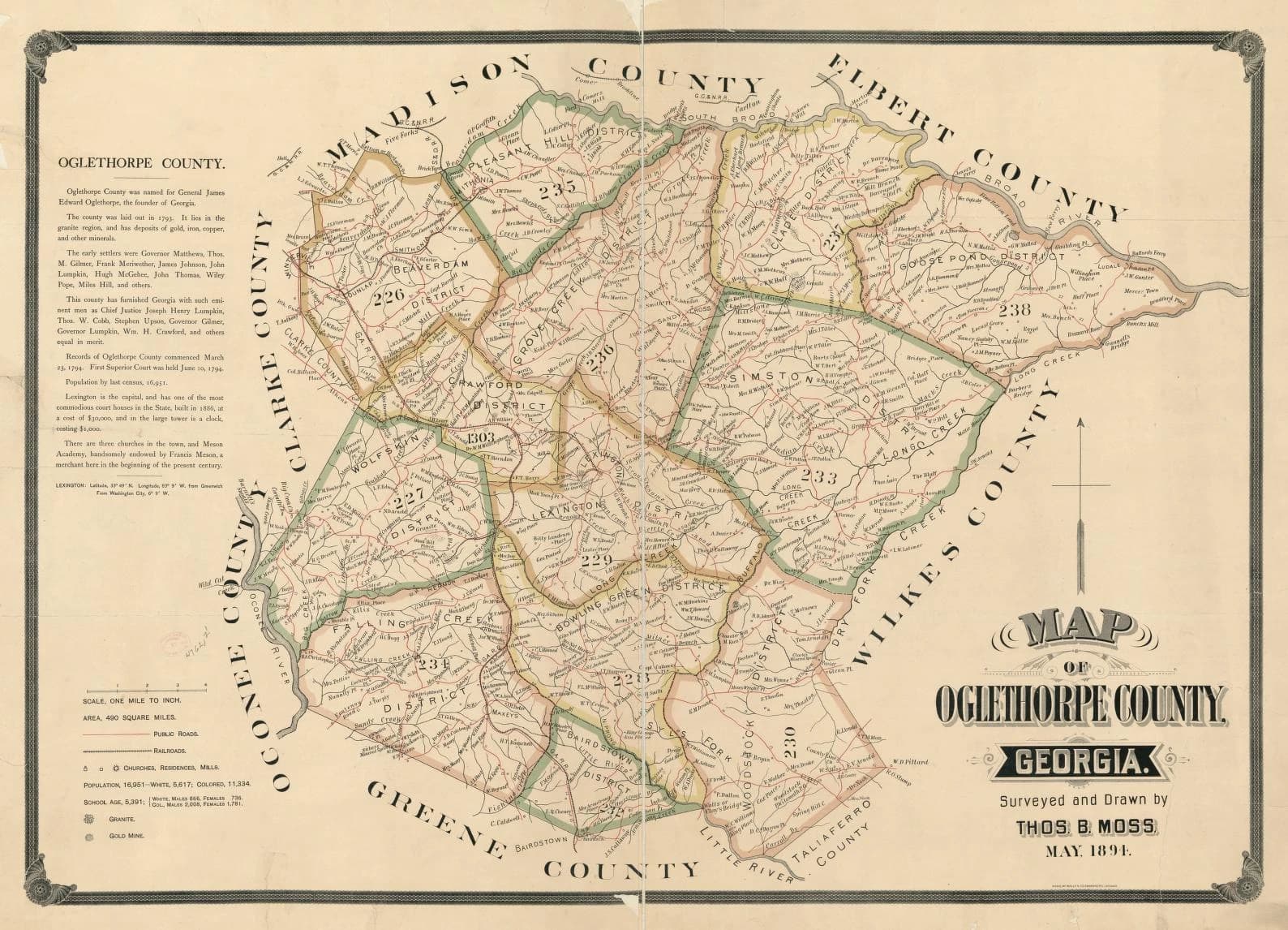
This map shows more than land. It shows a system.
The plantations in this district sat close together — close enough for enslavers to buy, sell, inherit, and divide Black families across neighboring households. Close enough for enslaved people to meet, marry, and try to hold onto one another despite a system designed to keep them vulnerable. In plantation Georgia, this was not unusual. This was how slavery worked.
For the enslaved, life here meant forced labor, constant surveillance, and family ties with no legal protection. A husband might live on the next plantation and still need permission to see his wife. A mother could be sold a few miles away and still disappear from her children's daily lives. A probate division could scatter siblings across households that all appeared on the same map.
Many of the enslavers in this world were also rapists. They violated Black women, fathered children through force, and then enslaved those children as property. They used law, family, church, and custom to protect themselves while the people they harmed were entered into inventories, wills, and tax records as assets.
Use the map above to explore the households connected to our family. Click any highlighted plantation to learn which ancestors were tied to it, what records survive, and how those households shaped our family's history.
But the map also tells another story. Across these same plantations, enslaved people found one another, built families, shared memory, and created communities that survived every household that tried to break them.
Enslaver Households
The Eberhart/Strickland Line: From Feudal Lords to Enslavers
A long-view narrative linking medieval Strickland power, colonial violence, and Georgia slavery to the post-Emancipation survival and migration of Wiley Strickland and Dinah Hawkins.
- Walter de Strickland
- Henry Peter Strickland
- John Strickland
- James Strickland
- Wiley Strickland
- Dinah Hawkins
- Chaney Watkins
- Bob Eberhart
- Louise Strickland Eberhart
- Samuel Eberhart Strickland
Core Narrative: From England to Georgia
- Traces Strickland origins to medieval Westmorland and long-term elite landholding structures.
- Frames transatlantic migration as continuity of domination systems, not a break from them.
- Links colonial militia violence (Pequot/King Philip's War era framing) to later southern plantation expansion.
Madison County Focus: Strickland House and Probate Trail
- Henry Peter Strickland (1748-1838) is positioned at Danielsville's Strickland House (c.1790), later county-courthouse use.
- Narrative emphasizes surviving architecture versus missing names of enslaved builders and residents.
- 1838 probate and 1860 slave-schedule records for John/James Strickland are prioritized for full transcription.
Enslaved-to-Freed Continuity
- Age-sex profiles in 1860 schedules are interpreted against known family lines (Wiley, Chaney, close kin).
- Post-1865 continuity shows freed families often remaining on the same land under sharecropping debt structures.
- Wiley and Dinah later appear in Clarke-area corridors tied to prior enslaver geographies.
Mission Statement (Research Objective)
- Identify specific enslavers/plantations tied to Wiley Strickland, Dinah Hawkins, and related lines.
- Correlate surnames (Strickland, Hawkins, Newton, Watkins, Eberhart) with slave schedules, probate, deeds, and Bureau contracts.
- Determine which plantation-era structures or sites still exist and map them to descendant movements.
Key Georgia Research Tracks
- Strickland line: Madison probate, deed transfers, and 1860 slave schedule extraction.
- Eberhart line: Oglethorpe/Madison probate plus Freedmen's Bureau labor linkages.
- Hawkins/Newton line: probate, Lexington church records, and Athens-area labor contracts (1865-1868).
Migration and Industrial North Context
- Positions Wiley/Dinah within Great Migration movement from rural Georgia to Lansing, Michigan.
- Connects family labor to Lansing auto-industrial economy (Oldsmobile/REO context) and neighborhood settlement patterns.
- Highlights need for city directories, draft cards, death certificates, and church records to sequence migration timing.
Supplemental Leads and Open Questions
- Possible Prohibition-era Strickland court/newspaper references in Lansing.
- Potential church/NAACP/community organization footprints in Lansing's Black institutions.
- Need for map overlays: historic plats, Danielsville Road corridor, and later Lansing residential/work nodes.
High-Value Next Steps
- Transcribe Henry Peter Strickland probate and all 1860 Strickland slave-schedule lines.
- Reconstruct 1870-1940 household chain for Wiley/Dinah and children across GA -> MI.
- Pull Freedmen's Bureau labor/marriage records for Strickland, Watkins, Hawkins, and Eberhart-linked families.
- Anchor plantation-to-freedom geography with deed/plat overlays and surviving structure documentation.
- Use DNA triangulation to test hypothesized links across Black and white descendant lines.
Additional Family Census Link
- https://docs.google.com/document/d/1v1GJ7wenh9-bhMg8xpCuXmDGdeLApnbBrLZv-u0h-Vk/edit
Source
- https://docs.google.com/document/d/1Ut795pAdkyChHSZ5GW5Y9hCHX1_k5k0MnWbXZJVfV98/edit?usp=drivesdk